
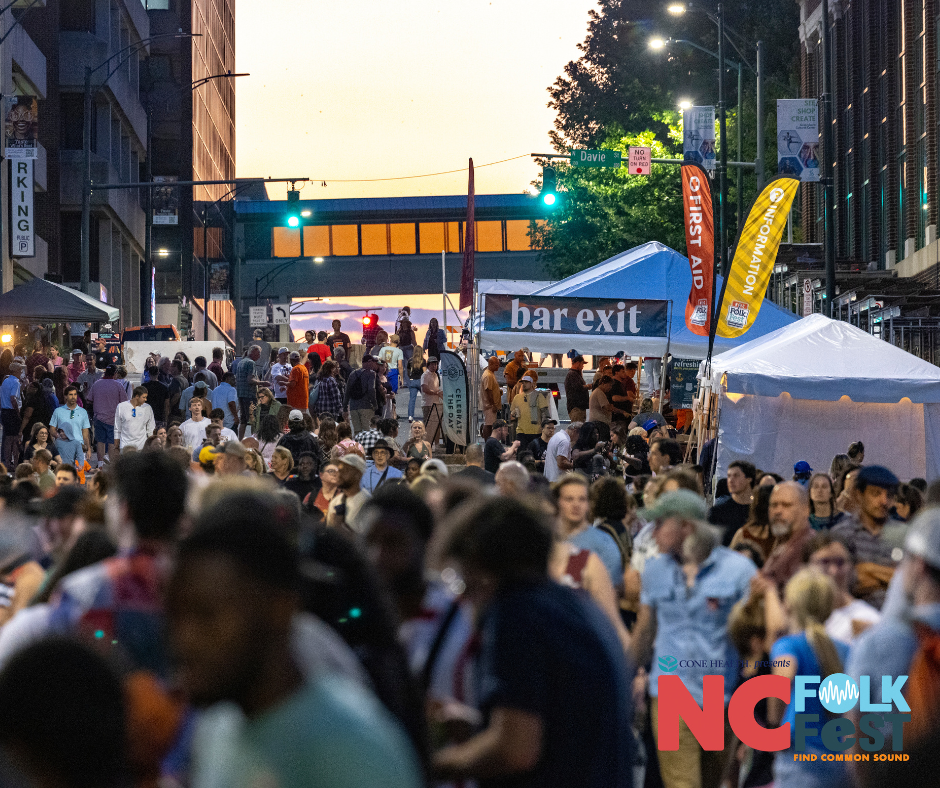
Since launching in 2018, the North Carolina Folk Festival has turned Greensboro into a free, open door for music lovers, with a bill that stretches from bluegrass and Americana to hip hop, soul and jazz. This year brought names like The Roots, Molly Tuttle and St. Paul & The Broken Bones, all without charging a penny for tickets. We caught up with Savannah Thorne, the Artistic Director at NC Folk Festival to talk about what “folk” really means, how they pull off a lineup like that for free, and what visitors shouldn’t miss away from the main stages.
Hello, Savannah. The festival has grown a lot since it started in 2018. What has changed the most, and what have you worked hard to keep the same?
Since 2018, the North Carolina Folk Festival has grown tremendously, adding stages, expanding our pre- and post-festival programming, and creating more opportunities for audiences to engage with their own creativity. What we’ve worked hard to preserve is our commitment to being a free, accessible festival that celebrates the traditions and creativity of communities from around the world.
We’ve also intentionally held onto the word “folk” in our name, even though it can sometimes create assumptions about the kind of music people will encounter here. We want to expand the understanding of folk beyond Southern roots and Americana to include any tradition rooted in community, storytelling, and shared experience. At its heart, we believe folk music is rooted in the folks who make it.
This year’s lineup ran from bluegrass and Americana to hip hop, soul and jazz. How do you decide what counts as “folk” when you’re putting the bill together?
For us, folk isn’t a genre so much as a way of understanding how music connects us to one another. We look at the traditions, stories, communities, and lived experiences behind the music, whether that’s bluegrass passed down through generations or hip hop that speaks to the realities of a community today. We’re interested in how artists carry their traditions forward, reinterpret them, and create something new for the next generation. That means making room for music from across the world, across generations, and across genres. Ultimately, we want audiences to leave with a broader understanding of what folk music can be, and recognize that their own stories and traditions belong in that definition, too.
Getting acts like The Roots, Molly Tuttle and St. Paul & The Broken Bones for a free event is a real coup. How do you make that happen without charging for tickets?
It takes a tremendous amount of partnership, planning, and community investment to bring artists of that caliber to a free festival. Corporate sponsors, foundations, individual donors, and public support make it possible for us to pay artists fairly while keeping the festival accessible to everyone.
We also work hard to build relationships with artists and their teams, and to position Greensboro as a meaningful stop for musicians who want to connect with new audiences. Being free doesn’t mean the festival is inexpensive to produce; it means we believe the opportunity to experience extraordinary music shouldn’t depend on someone’s ability to buy a ticket. That accessibility is central to our mission, and it’s only possible because our community believes in the value of the arts.
More than half of your crowd travels from outside the Triad. What do you hope first time visitors take away from Greensboro beyond the music?
I hope visitors leave with a sense of how creative, welcoming, and culturally diverse Greensboro really is. Sometimes people arrive with a narrow idea of what North Carolina or the South looks like, and I hope their experience here challenges some of those assumptions. Greensboro is a place where many different communities, histories, and traditions intersect, and the festival is one expression of that richness. I’d love for visitors to explore our local restaurants, businesses, arts spaces, and neighborhoods, and to see the city as a destination in its own right. Most of all, I hope they leave feeling connected to a place and a community they might not have known before.
Away from the main stages, you’ve got the makers’ marketplace, folklife programming and family jam sessions. Which of those should people make a point of not missing this year?
That’s a difficult choice because each of those spaces offers a different way to experience folk culture beyond watching a performance. I always encourage people to visit our Folklife programming, where they can meet tradition-bearers and artists, learn directly from them, and see how cultural traditions are practiced and shared in everyday life.
The Makers Marketplace is also a wonderful opportunity to connect with the people behind the work and support the artists who keep these creative traditions thriving. And our jams are especially meaningful because you don’t have to be a professional musician, or even a musician at all, to participate and experience the joy of making music together. If I could give visitors one piece of advice, it would be to leave some room in their schedule to wander, get curious, and participate; some of the most memorable festival moments happen away from the main stages.
For more information on the North Carolina Folk Festival visit their official site here.

- Mason McNulty Interview - November 13, 2026
- Diamonds and Guns “Degenerate Nonsense” Review - November 2, 2026
- Jessmin “Hyperfixated” Review - November 2, 2026

